Taxonomy I: What's in a name?
Listen to this reading
Did you know that people started classifying living things as early as 300 BCE? But our modern classification system officially began in the 18th century when Carolus Linneaus listed every plant and animal species known in the world – more than 12,000 in all. He produced one of the great works in the history of science, Systema Naturae, which we still use today.
Many people whose life and work depend on the natural environments are highly aware of the organisms around them. People who subsist on the food they grow or hunt, whether they are farmers in the rural United States or native hunter-gathers in the Amazon rainforest, are attuned to the variety of organisms around them, and can easily describe their benefits and problems. Some scientists have found that we have a genetic, instinctual fondness for nature that explains why humans are so preoccupied with plants and animals.
But there are surely practical reasons, too, for carefully observing behaviors and patterns in organisms. For those living off either a lush rain forest or the inhospitable Arctic, local plants and animals can provide food, shelter, clothing, and fuel for cooking fires or warmth. Even in less extreme regions, a basic knowledge of environmental biology, including food-related facts like the fruiting patterns of trees and the grazing habits of large mammals, has always been important to survival, so it has become a significant part of the cultural traditions of people virtually everywhere. As you might expect, each culture has its own system for naming the plants and animals with which they live.
The process of naming and classifying organisms according to set of rules is called taxonomy. In some cultures, taxonomic rules are based on traditional uses for plants and animals, and the existence of a classification system facilitates the transfer of that knowledge through generations. In modern scientific culture, taxonomic rules are based on physical appearance as well as genetic and evolutionary relationships between species, but having a classification system serves a very similar purpose by allowing scientists to communicate efficiently and effectively about the nature of a given organism with only a few words.
Comprehension Checkpoint
Early history of taxonomy
Among Europeans, we can trace the beginnings of organized, written taxonomies to ancient Greece. As early as 300 BCE, the philosopher and naturalist Theophrastus, a disciple of Aristotle, classified plants into three categories: herbs, shrubs, or trees. In addition to classifying local specimens, Theophrastus was able to add species from other regions because Alexander the Great sent him specimens collected during his expeditions to conquer much of Europe and Asia.
During the 16th and 17th centuries, another round of famous expeditions marked the Age of Exploration. Dozens of explorers, including Ferdinand Magellan, Henry Hudson, and Hernando Cortes, traveled to distant parts of the globe and returned not only with stories of what they had seen, but also with samples of the plants and animals they encountered. European naturalists were kept busy describing these many new species and naming them in Latin, which was the language generally used for scholarly purposes.
By the 19th century, the idea of collecting exotic species became common practice and laid the foundation for research in the natural sciences. Charles Darwin, who developed the modern theory of evolution by natural selection in the middle 1800s, was one of many naturalists commissioned to collect, record, and describe the species he saw during his travels.
Cataloging of species
Progress was also being made cataloging the kinds of plants and animals that existed. Naturalists in the 17th century, such as John Ray, began to develop a scientific basis for recognizing species. Ray and others began to inventory species by arranging them into logical classes based on their appearance and characteristics.
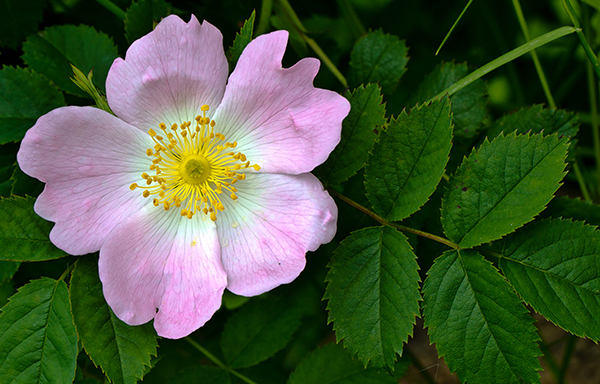
As a result of this widespread effort to describe new species, names proliferated, resulting in overlaps and redundancies and a lot confusion. Without sharing commonly accepted standards for composing names – even regarding such a simple rule as how long a name ought to be – the whole purpose of a classification scheme as a communication tool is lost. For example, before a widely accepted taxonomic system was in place, the common Wild Briar Rose was identified by botanists as Rosa sylvestris alba cum rubore, folio glabro roughly meaning 'pinkish white woodland rose with hairless leaves'), and Rosa sylvestris inodora seu canina ('odorless woodland dog rose'). How was one to know if these names referred to one thing or two, that is, to one or two species?
Comprehension Checkpoint
Carolus Linnaeus and modern taxonomy
|
|
Old naming convention Rosa sylvestris alba cum rubore folio glabro Rosa sylvestris inodora seu canina |
|
Linnaean System Rosa canina |
In the 18th century, the Swedish scientist Carolus Linnaeus more or less invented our modern system of taxonomy and classification. Linnaeus was one of the leading naturalists of the 18th century, a time when the study of natural history was considered one of the most prestigious areas of science.
Unlike his predecessors, Linnaeus adhered rigidly to the principle that each species must be identified by a set of names, which are termed the "genus" and "species," and classified on the basis of their similarities and differences. Although he was primarily a botanist, Linnaeus produced a comprehensive list of all organisms then known worldwide, some 7,700 plant and 4,400 animal species. He wrote one of the great classic works in the history of science, Systema Naturæ, and revised it many times.
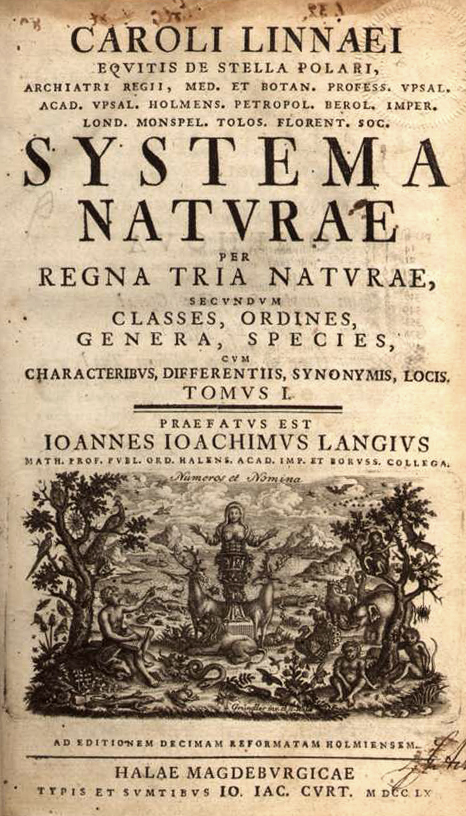
We now consider the 10th revision of Systema Naturæ, published in 1758, as the official start of modern taxonomy and the first formal biological classification. It is a benchmark of modern taxonomy, an important reference to help biologists keep the many names straight. This is why when we come across taxonomic names, such as the official-looking labels identifying an animal in the zoo, Linnaeus's authorship is often acknowledged, and no dates of authorship are ever earlier than 1758. For instance, the plaque outside a gorilla exhibit may read as:
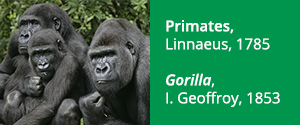
This is more than a simple caption. Its purpose is to let us know, clearly, that the gorillas on display are the same type of animal that the French naturalist Isidore Geoffroy named Gorilla in his publication of 1853. It also tells us that the gorilla belongs to a group of mammals known as Primates, which in turn was named by Linnaeus in the 10th edition of his Systema Naturæ. Where did that odd name “gorilla” come from? As far as we know, it was introduced to Europe by the Greek explorer Hanno, who visited northwestern Africa during the sixth century BCE. It was the word that Hanno thought the local African people used to call gorillas (and supposedly meaning wild or hairy women). In other words, it was adopted by Hanno and is still in fashion today after being introduced into the formal Linnaean taxonomic system by Geoffroy in 1853.
Comprehension Checkpoint
Table of Contents
Activate glossary term highlighting to easily identify key terms within the module. Once highlighted, you can click on these terms to view their definitions.
Activate NGSS annotations to easily identify NGSS standards within the module. Once highlighted, you can click on them to view these standards.